
How to Rent an Apartment in Taipei as a Foreigner (Step by Step, 2026)
By Raytio RayUpdated
How to rent an apartment in Taipei as a foreigner, step by step: budget, area, where to search, viewings, the contract, deposit, move-in and your ARC address.
Here is how to rent an apartment in Taipei as a foreigner, in one paragraph: set a total budget that includes two months' deposit, pick two or three neighborhoods by commute, arrive and stay somewhere short-term, search 591 and a few other channels, view units in person, read the contract before you sign, pay a deposit of no more than two months' rent, and register the address for your ARC. Done well, the in-person part takes one to two weeks.
The process isn't complicated. What makes it hard for foreigners is that almost every step happens in Chinese, and a few of them, especially the address registration, can go wrong quietly. This is our step-by-step version, the one we walk clients through, with a link at every step to the detailed guide. Our one strong recommendation before you start: don't sign or pay anything until you've stood in the apartment. Everything below is built around that rule.
Step 1: Set your budget, including the upfront cash
Rent is only part of it. When you sign a typical Taipei lease you hand over the first month's rent plus a deposit, and the law caps the deposit at two months' rent (Rental Housing Market Act, Article 7). That is three months of rent on day one, plus half a month more if you rent through an agent.
For a sense of the market, the Ministry of the Interior's first-half 2026 data put Taipei's overall median rent at NT$12,500 and the median studio at NT$15,000 (ETtoday, August 2026). Those figures come from subsidy contracts and can run below typical asking rents. Our Taipei rent guide by area gives our own rough ranges by district, and our hidden costs guide covers management fees and electricity. For the full monthly picture, see the cost of living in Taipei.
Our rule of thumb: keep rent under half of your take-home pay, and arrive with at least four months of rent in cash available.
Step 2: Choose two or three areas by commute
Don't pick a district by reputation. Pick it by how long it takes to get to work or school, then narrow down to two or three pockets near an MRT station. An apartment one stop from your office on the same line almost always beats a "nicer" area with two transfers.
Our guide to the best area to live in Taipei for foreigners compares every district side by side. If you want one default for a first move, ours is Zhongshan. For more detail, we have district guides for Da'an, Zhongshan, the East District and Neihu.
Step 3: Decide what kind of unit you want
Taipei listings fall into a few types: 雅房 (a room with a shared bathroom), 分租套房 (a room with its own bathroom in a shared flat), 獨立套房 (a self-contained studio) and 整層住家 (a whole apartment). For a single newcomer, a studio is usually the right fit. Read suite, shared room or whole floor for what each one means in practice, and roommates or a whole apartment if you're unsure whether to share.
Two building questions matter more than people expect. Walk-up or elevator: see walk-up vs elevator buildings. And rooftop additions: we recommend avoiding them, for reasons in our guide to rooftop additions and subdivided units. Also decide early whether you need the place furnished, because "furnished" in Taipei often means less than you'd assume (furnished vs unfurnished).
Step 4: Time your arrival and book a short stay
Most Taipei landlords want a tenant who can view this week and move in within a few weeks. That's why the search really starts when you land. Book one to two weeks in a hotel or short-stay apartment near your shortlisted areas, and plan to view units in your first days. Our guide on where to stay your first two weeks covers the options.
Timing helps too. Late summer, when students arrive, is the most crowded season; our guide to the best time of year to rent in Taipei explains when you'll have more choice and more room to negotiate. If you're still overseas while planning all this, read our guide to renting in Taipei from abroad.
Step 5: Search where the listings actually are
The biggest source by far is 591.com.tw, which is in Chinese only. Our guide to using 591 in English shows how to translate it, which filters to set, and how to message landlords. For rooms, sublets and lease takeovers, Facebook groups are the other main channel. Our own group, Taiwan Rental Assistance, is a good place to start and to ask questions; we compare every option in alternatives to 591.
You'll also meet agents. Some listings are posted by owners, others by agents who usually charge the tenant half a month's rent. Our article on whether you need an agent in Taipei explains who they work for. Learn the listing vocabulary before you start messaging: how to read a Taiwanese rental listing covers 坪, 押二付一 and the rest.
Expect some owners to say no once they realize you're a foreigner. It happens, and it's usually about language and paperwork, not you. Our guide to when a landlord won't rent to foreigners explains what helps.
Step 6: View in person, with a checklist
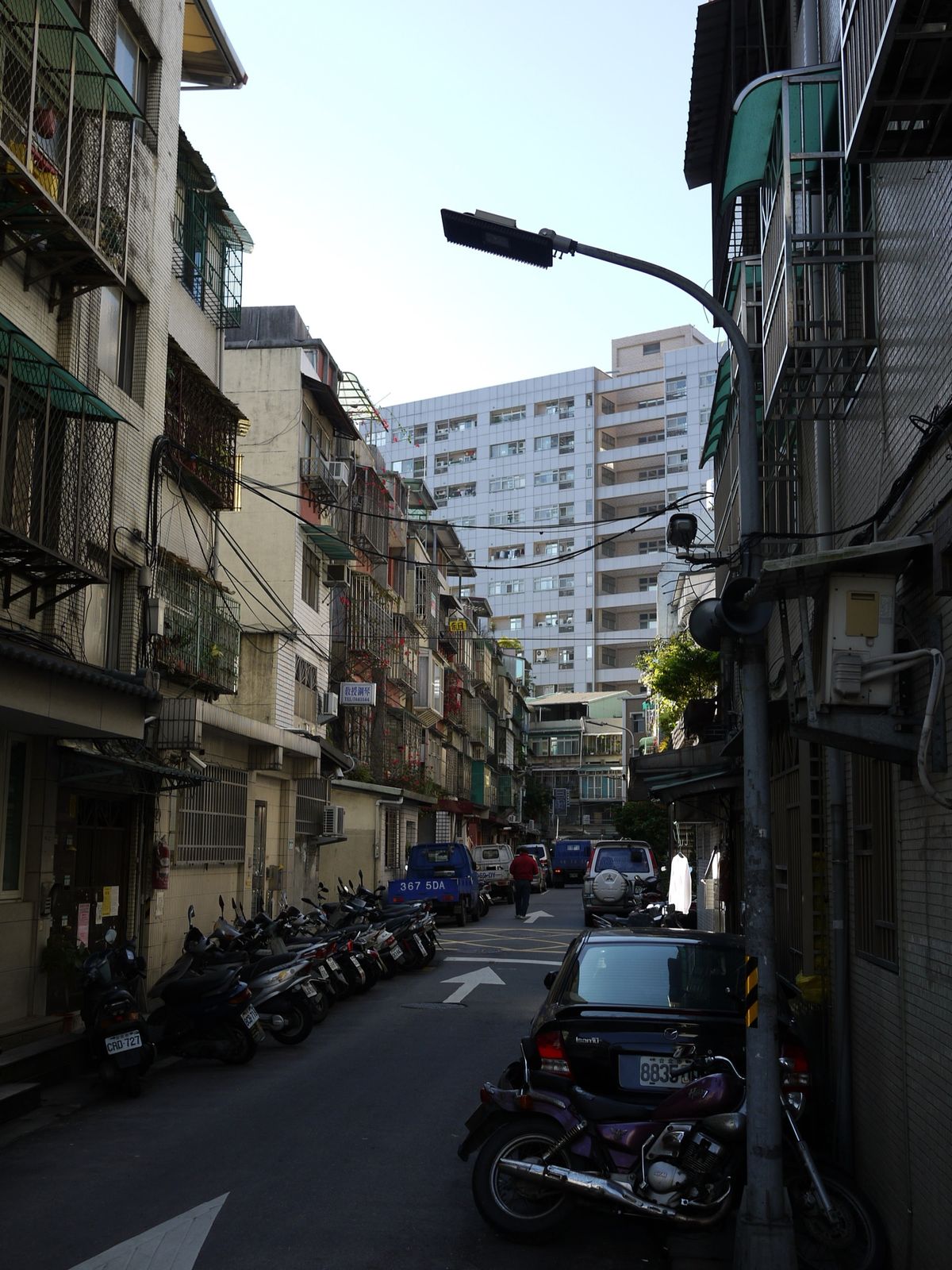
Photo: Bernard McManus via Wikimedia Commons, CC BY 2.0
A viewing is where you find out what photos hide: mold on a back wall, a gas water heater inside an enclosed balcony, a scooter-heavy lane under the bedroom window. Bring your passport, a way to pay a deposit if you like the place, and a list of questions. Our apartment viewing checklist covers what to bring, and five questions to ask a Taiwanese landlord before you sign covers what to ask.
Two safety checks never to skip: where the gas water heater is (gas water heaters and carbon monoxide) and signs of damp (humidity, mold and typhoons). And the rule from the top of this guide: if anyone asks for money before you've viewed the unit, walk away. Our guide to common rental scams targeting foreigners shows the usual patterns.
Step 7: Negotiate before you agree
Rent in Taipei is often negotiable, especially on units that have sat empty, on longer leases, and outside the summer rush. You can also negotiate what's included: a new mattress, a repaired air conditioner, management fees. It works best in Chinese, face to face, at the viewing or right after. Our guide to negotiating rent with a Taiwanese landlord has the specifics.
Step 8: Read the contract before you sign
Ask for the contract before signing day if you can, and run it through a translator. The Ministry of the Interior publishes an official residential lease contract template, and a fair contract will look broadly like it: lease length, rent and payment date, deposit amount and return, who repairs what, utilities, and early termination terms.
Our guide to what a normal Taipei rental contract looks like walks through each clause. The clauses that cause foreigners the most trouble are usually in the fine print: rent quoted "excluding tax", electricity billed by the landlord at a high per-unit rate, a sub-landlord who isn't the owner, and a ban on registering your address. All four are in our rental fine print guide.
Step 9: Pay the deposit and sign
On signing day you usually pay the deposit and the first month's rent, either in cash or by bank transfer, and both sides sign two copies of the contract. Check these before money changes hands:
- The person signing is the owner, or has written authority from the owner. Ask to see the ownership document or the agent's license.
- The deposit is no more than two months' rent. That's the legal ceiling.
- You get a receipt for every payment, and your copy of the signed contract.
- The move-in condition is recorded. Take dated photos and video of every room, appliance and existing damage, and send them to the landlord the same day. This is what gets your deposit back later.
You don't need an ARC to sign. A passport is normally enough, though some landlords ask for proof of a job or school. If you're still waiting for your ARC, our article on renting without an ARC explains how to handle the order of things.
Step 10: Move in and set up the basics
Before you unpack, clean. Many Taipei rentals are handed over "as is", and our TRA Live team explains what that means in move-in cleaning in a Taiwanese rental. Then sort out the services: how your utility bills work, and setting up home internet. If you're moving from another apartment in the city, see moving apartments in Taipei.
Step 11: Register your address for your ARC
This is the step that quietly goes wrong. If you enter Taiwan on a resident visa, you need to apply for your ARC within 30 days, and the application asks for your address. The National Immigration Agency's residency guidelines list what to bring. Some landlords don't want tenants registering an address, often for tax reasons, and some never say so until you ask. Confirm it in writing before you sign.
If you move later, your ARC address has to be updated too; see updating your ARC address after you move and our explainer on household registration in Taiwan.
Step 12: Know how the lease ends
Most leases run one year. Before signing, check how much notice you must give, what happens if you leave early, and when the deposit comes back. When the time comes, our guide to what happens when your lease ends covers renewal, moving out and getting your deposit back in full.
The shortcut: let TRA walk every step with you
Every step above is doable on your own. The difficulty is doing all of them in Chinese, quickly, in your first two weeks in a new country. That's the job TRA was built for.
- Consultation: we go through your budget, workplace or campus, and how you want to live, and suggest the areas that fit.
- Search and viewings: we line up listings and view them with you in person, handling every conversation and negotiation with the landlord in Chinese, including confirming that you can register your ARC address.
- Contract: we go through the lease clause by clause before you sign, so you know exactly what you're agreeing to.
- Signing and move-in: we help finalize the deposit and signing on the spot.
Once the in-person search starts, finding the right place typically takes anywhere from 3 to 5 days up to about 1 to 2 weeks. You pay a deposit when we start and the balance once you've found your home; we quote individually. Our TRA Live team can add an airport pickup and a move-in clean. See how our service works or tell us when you arrive.
FAQ
Can a foreigner rent an apartment in Taipei without an ARC?
Yes. Most landlords accept a passport to sign. The catch is that you'll need the address for your ARC application, so confirm before signing that the landlord allows address registration.
How much money do I need upfront to rent in Taipei?
Usually three months of rent: a deposit of up to two months (the legal maximum) plus the first month. Add half a month's rent if you go through an agent.
How long does it take to find an apartment in Taipei?
Searching on your own commonly takes two to four weeks. With TRA, once the in-person search starts, finding the right place typically takes anywhere from 3 to 5 days up to about 1 to 2 weeks.
Can I rent an apartment in Taipei before I arrive?
You can, but we don't recommend paying for a unit you haven't seen. Book a short stay instead and view in person; our guide to renting from abroad explains the safer way.
Is it safe to rent through 591?
Mostly. The risk isn't the platform, it's paying before viewing. Never transfer money until you've seen the unit and confirmed the person signing is the owner or the owner's authorized agent.