
The ARC Chicken-and-Egg Problem: Renting Without an ARC Yet
By Raytio RayUpdated
The ARC Taiwan rental loop explained: landlords want an ARC, the ARC needs an address. What to show landlords instead, and a 30-day plan that breaks the loop.
Yes, you can rent in Taipei without an ARC. The loop people worry about, where landlords want an Alien Resident Certificate and the ARC application wants an address, breaks when you do things in the right order: arrive on a resident visa (or the status that entitles you to residence), stay somewhere short-term, sign a normal lease with a landlord who agrees to ARC registration, then use that lease as your proof of address. The National Immigration Agency gives you 30 days after arrival to apply, which is enough time if you start viewing in your first week. That's the whole ARC Taiwan rental problem, solved by sequence.
Our recommendation: book one to two weeks of short-term accommodation, show landlords your passport and resident visa (plus your work permit, Gold Card or admission letter) instead of an ARC, ask the ARC address question before anything else, and submit your ARC application within days of signing. The rest of this guide explains each piece of that ARC Taiwan rental sequence.
Why the ARC Taiwan rental loop exists
From the landlord's side, an ARC is the easiest proof that you're legally staying for a while, and that you'll still be here in month six. Some landlords have had a tenant leave the country mid-lease, and an ARC feels like a guarantee.
From the immigration side, the National Immigration Agency's residency guidelines list "proof of current residence" among the documents for an ARC: "such as a lease agreement". If you live with the owner instead, they accept a copy of the ownership certificate, or a copy of the owner's ID card with their written consent.
So each side wants the other document first. The way out is that a landlord doesn't actually need your ARC. They need confidence that you're legal, solvent and staying. You can give them that with other documents.
What to show a landlord instead of an ARC
- Document: Passport with resident visa | What it tells the landlord: You're entitled to live here, not just visiting
- Document: Work permit or employment contract | What it tells the landlord: You have income and a reason to stay
- Document: Employment Gold Card | What it tells the landlord: Work permit, resident visa and ARC in one card
- Document: School admission letter or student ID | What it tells the landlord: You'll be here for the semester or the year
- Document: Marriage registration (spouse visa) | What it tells the landlord: Long-term family ties in Taiwan
Bring paper copies to viewings. Our viewing checklist covers the rest of what to bring.
One honest caveat: some landlords will only rent to tenants who already have an ARC, whatever you show them. That's their choice, and there are enough other landlords that it isn't worth arguing. Our guide to when a landlord won't rent to foreigners in Taiwan explains how to filter for the ones who will.
What to say to a hesitant landlord
Many landlords who hesitate aren't against foreigners. They're worried about three specific things, and you can answer each one directly:
- "Will you leave in the middle of the lease?" Show the length of your work permit, contract or study program. Offer a one-year lease, the normal term in Taipei.
- "Can you pay?" Show an employment letter or offer, a scholarship letter, or a Gold Card. Offer a fixed monthly transfer date.
- "Will this cause trouble with paperwork?" Explain that the immigration office only needs a copy of the lease, and that you'll handle the application yourself.
A short, calm sentence in Chinese goes a long way here: 我有居留簽證,簽約後會用租約去申請居留證 (Wǒ yǒu jūliú qiānzhèng, qiānyuē hòu huì yòng zūyuē qù shēnqǐng jūliú zhèng), "I have a resident visa, and after signing I'll use the lease to apply for my residence card." If the landlord still says no, move on. Arguing rarely changes a landlord's mind, and you have limited days.
Which arrivals can actually apply for an ARC
The order above works when the reason you're here already entitles you to residence. According to the NIA guidelines:
- Resident visa holders (work, study, joining family and similar) apply within 30 days, counted from the day after arrival.
- Some visitor visa holders with a visa of 60 days or more can apply directly, for example foreign spouses or people with an approved work permit.
- Gold Card holders already have residence built into the card. You don't apply for a separate ARC, but you still register address changes.
- Most visa-exempt visitors can't apply for an ARC directly. If that's you, sort out the resident visa route with your employer or school first. Our Gold Card and residency guide compares the routes.
Late filing is fined NT$2,000 to NT$10,000 under Article 85 of the Immigration Act, so the 30 days are worth taking seriously.
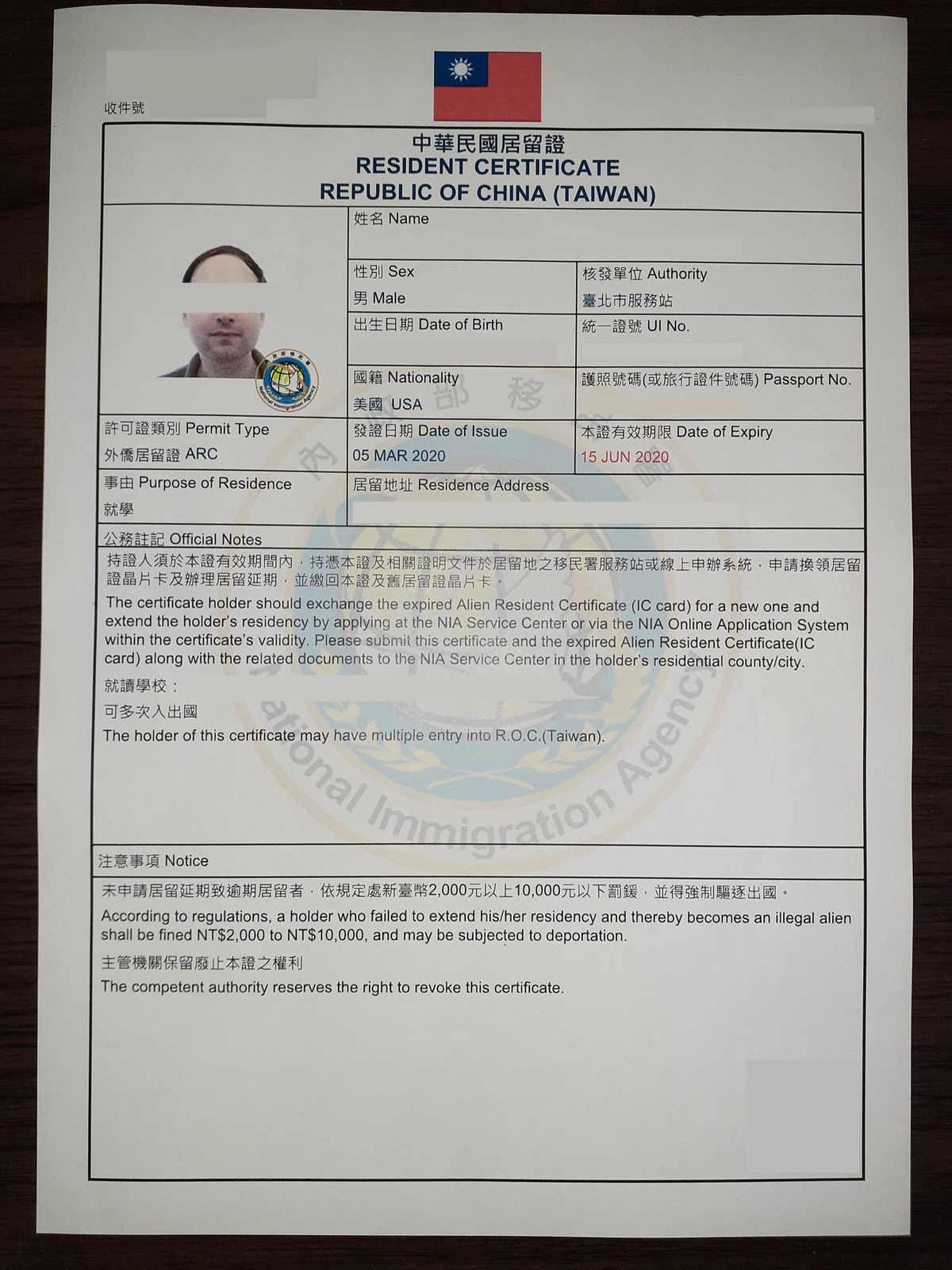
Photo: National Immigration Agency Taipei City Service Center via Wikimedia Commons, public domain
The 30-day plan that breaks the loop
- When: Before you fly | What to do: Get the resident visa (or Gold Card). Book 1 to 2 weeks of short-term accommodation.
- When: Day 1 | What to do: Land. Your 30 days start the next day. Put the deadline in your calendar.
- When: Days 2 to 4 | What to do: Start viewing. Ask the ARC address question first at every flat.
- When: Days 5 to 14 | What to do: Sign a lease with a landlord who has agreed, in writing, to ARC registration.
- When: Within days of signing | What to do: Submit the ARC application with your lease as proof of residence (online for some work permit and student categories, otherwise at the NIA service center).
- When: About 10 working days later | What to do: Collect the ARC, if nothing was missing.
Our guide to where to stay your first two weeks in Taipei compares hotels, hostels and serviced apartments for that first stretch. Note that stays under 30 days fall outside the Rental Housing Market Act (Article 4), so treat the short stay as a base, not a home, and don't count on it as your ARC address.
Why trying to solve it remotely backfires
The instinct is to lock in a flat before you fly so you land with a lease. It rarely works out:
- Good units in central Taipei are often taken within days, so a flat chosen from abroad is usually gone by the time you land, or the landlord picks the tenant they met in person.
- Landlords are far more comfortable with a foreigner they've met and whose documents they've seen.
- Photos hide what matters in Taipei: damp, noise, water pressure, the location of a gas water heater.
- Paying a deposit to someone you've never met, for a flat you've never seen, is exactly the setup most rental scams use.
This is why the search works best once you've landed. The in-person part isn't a formality. It's what lets the landlord say yes.
Make sure the lease actually works for your ARC
A lease is only useful for the ARC if it does three things:
1. Names you as tenant. If you're renting a room from another tenant, the sub-landlord needs the owner's written consent (Article 9), and you should confirm the NIA will accept your sublease.
2. Doesn't ban registration. A clause saying you can't register the address is void under the government's lease rules, but it's a sign the landlord will be difficult. Get a clear yes in writing.
3. Matches the address exactly. Floor, unit number and "之" sub-number should match the building's official address, or the application can be returned.
A common reason a landlord says no is tax: they don't declare rental income and fear a registered tenant leads the tax office to them. Our guide to Taiwan rental fine print explains how that plays out.
Students, spouses and Gold Card holders
Three groups have it slightly easier, and it's worth knowing why:
- Students usually get help from their university's international office, and many schools file the ARC through an online system. A dormitory place, even for one semester, also gives you a registered address while you look for a flat. Our campus housing comparison covers the main universities.
- Spouses of Taiwanese citizens often live with family at first, and the NIA accepts the owner's ownership certificate or ID with written consent as proof of address. See how the Taiwan spouse visa works.
- Gold Card holders can show the card itself to landlords, which answers the "are you legal and staying?" question in one go.
After you have the ARC
When you move later, you have 30 days to register the new address with the NIA. Our sister site covers updating your ARC address after you move and what household registration means for foreign residents. If an app or bank rejects your new card number, see which apps accept the new ARC number.
How TRA breaks the loop with you
We help newcomers get this sequence right.
- We start right after you land, with a consultation on budget, area and needs, and line up viewings in your first days.
- We explain your situation to landlords in Chinese, show them why your visa or permit makes you a safe tenant, and confirm ARC address registration before you get attached to a flat.
- We go through the contract clause by clause so it works for your ARC application, then help finalize the deposit and signing.
Once the in-person search starts, finding the right place typically takes anywhere from 3 to 5 days up to about 1 to 2 weeks, well inside the 30-day window. You pay a deposit when we start and the balance once you've found your home; we quote individually. Our sister service can also meet you at the airport and take you straight to your short-term stay. See how our service works.
Our pick
Don't try to solve this from abroad. Arrive on the right visa, book two weeks somewhere central, start viewing on day two, and only consider landlords who say yes to ARC registration in writing. If you follow that order, a lease within two weeks and an ARC application well before the deadline is a realistic target. If you'd like help, tell us your arrival date.
FAQ
Can I rent an apartment in Taiwan without an ARC?
Yes. Many landlords accept a passport with a resident visa, plus a work permit, Gold Card or admission letter. You then use the lease to apply for the ARC.
What counts as proof of address for an ARC application?
The NIA lists a lease agreement. If you live with the owner, a copy of the ownership certificate, or a copy of the owner's ID with their written consent, is accepted.
How long do I have to apply for an ARC after arriving in Taiwan?
Resident visa holders have 30 days, counted from the day after arrival. Late filing can be fined NT$2,000 to NT$10,000.
Can I use a hotel or Airbnb address for my ARC?
It isn't on the NIA's list of accepted proof, and stays under 30 days aren't covered by rental law. Plan to sign a proper lease within your first two weeks instead.
Can my landlord refuse to let me register my ARC address?
A lease clause banning registration is void, but a landlord can decline to rent to you. Ask before signing and get the answer in writing.