
Roommates or a Whole Apartment? Deciding What Actually Fits You
By Raytio RayUpdated
Taipei roommates vs living alone: what a shared room really saves, the legal setup that protects you, how to split bills, and our pick for students and workers.
Living with Taipei roommates saves real money: Ministry of the Interior data for the first half of 2026 put the city's median for a shared room at NT$9,800 a month, against NT$15,000 for a studio. But the saving only holds if the setup is clean. Everyone needs to be on a lease or a written sublease, electricity has to be split fairly, and someone has to be able to talk to the landlord when the water heater breaks.
Our recommendation: if you're a student or on a tight first-year budget, take a private room in a shared flat, but only where your name is on a lease or a sublease backed by the owner's written consent. If you're working full time, staying a year or more, working from home, or moving as a couple, rent your own studio or apartment. Below is how the options compare, what each costs, and the paperwork that protects you either way.
The four ways to live in Taipei
Taipei listings use specific words for each setup. Our guide to Taipei apartment types covers them in detail; here's the short version:
- Setup: Room, shared bathroom | Chinese: 雅房 | What you get: A bedroom; bathroom and kitchen shared | Who it suits: Students, tight budgets
- Setup: Room with its own bathroom in a shared flat | Chinese: 分租套房 | What you get: Bedroom plus private bathroom; kitchen and living room shared | Who it suits: Students, first-year workers
- Setup: Studio | Chinese: 獨立套房 | What you get: Your own small unit with bathroom, often a mini kitchen | Who it suits: Single professionals
- Setup: Whole apartment or floor | Chinese: 整層住家 | What you get: Two or three bedrooms, living room, kitchen | Who it suits: Couples, families, friends sharing
"Roommates" can mean two very different things: renting a room in a flat that the landlord manages (雅房 or 分租套房), or a group of friends renting a whole apartment together (整層) and splitting it. The legal setup and the risks are different.
What sharing actually saves
Using the Ministry's figures, which come from rent-subsidy contracts and can run below typical asking rents (UDN, August 2026):
- Shared room: NT$9,800 median citywide. Shilin, Beitou, Zhongzheng and Wenshan come in under NT$10,000; Songshan is the most expensive at NT$12,000.
- Studio: NT$15,000 median citywide, NT$18,000 in Da'an and Xinyi, NT$19,500 in Neihu.
In central districts, our Taipei rent prices guide shows studios running higher still. So sharing typically saves several thousand NT dollars a month on rent alone, and usually more once you split the internet, the management fee and the cost of a washing machine and fridge you'd otherwise buy.
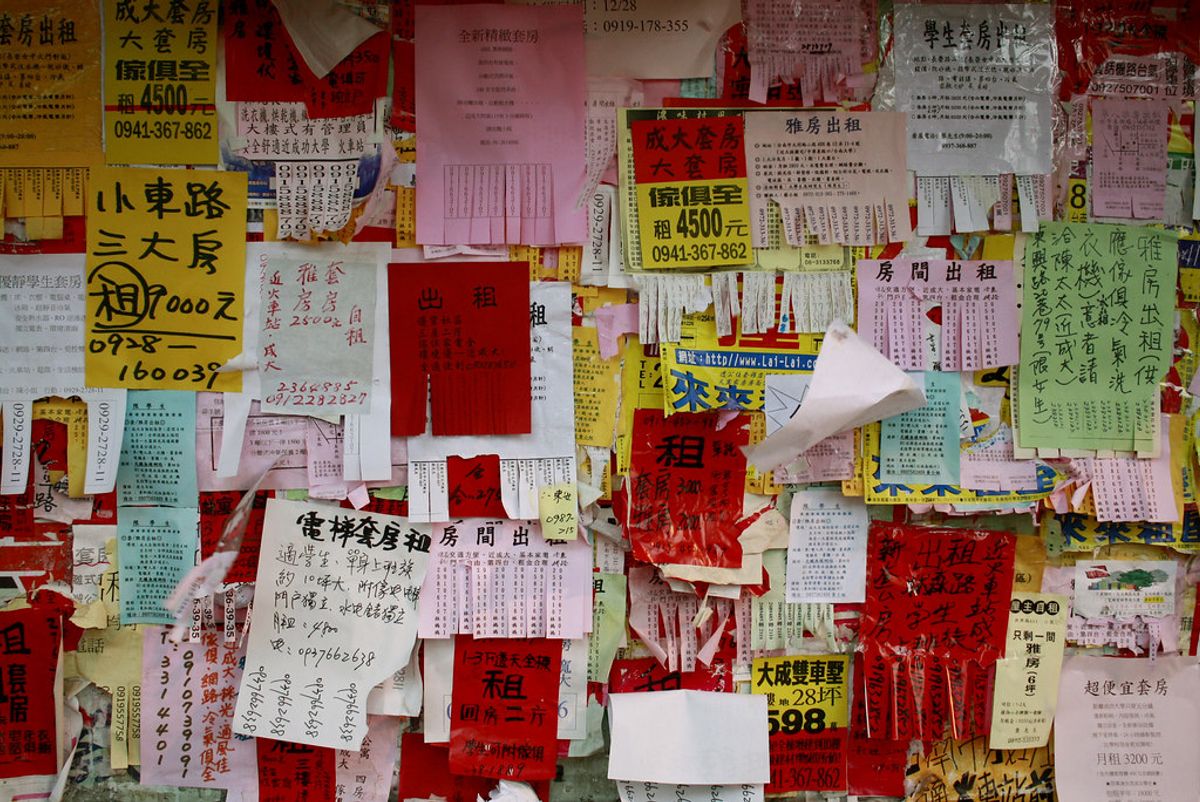
Photo: orange74 via Flickr, CC BY-SA 2.0
The case for Taipei roommates
- Location you couldn't otherwise afford. A room in Da'an near your campus can cost less than a studio across the river.
- A softer landing. In your first months, flatmates are often your first friends, your first source of "where do I buy a fan", and someone to help when a delivery driver calls in Chinese.
- Furnished by default. Shared flats usually come with the kitchen, washing machine and fridge already there.
- Shorter commitments. Room leases are sometimes more flexible than whole-flat leases.
The case against
- You don't choose who moves in next. In landlord-managed shared flats, the tenant who replaces your favorite flatmate is the landlord's pick.
- Shared spaces mean shared friction. Kitchen cleanliness, guests, noise and the thermostat are the classic fights.
- Electricity disputes. Shared flats often use sub-meters or splits, which is where overcharging happens.
- Less control over the landlord relationship. If someone else holds the main lease, you depend on them.
Whole apartment: when it's worth paying more
Rent your own place if any of these apply:
- You work from home or take calls at odd hours.
- You're staying 12 months or more.
- You're moving as a couple, or family may join you.
- You value quiet more than a few thousand NT dollars a month.
A whole apartment shared by friends is a good middle ground, as long as the paperwork below is done properly.
The paperwork that protects every roommate
This is the part most guides skip, and it's where shared setups go wrong.
1. Everyone needs a contract with someone entitled to rent. If the landlord rents you a room directly, you sign with them. If a friend holds the main lease and rents you a room, that is subletting, and under Article 9 of the Rental Housing Market Act it needs the owner's written consent, which the head tenant must show you. Without it, the owner can end the main lease and everyone loses the flat.
2. Everyone needs to be able to register the address. Your ARC application needs proof of where you live, "such as a lease agreement", according to the National Immigration Agency's residency guidelines. A roommate with no paper is a roommate who can't get an ARC.
3. Deposits should go to whoever holds the lease. Paying a deposit to a departing tenant who "transfers" their room to you is one of the classic traps. See rental scams targeting foreigners in Taipei.
4. Electricity should be split by a rule you can check. If the landlord charges per kWh from a sub-meter, the rate can't exceed the average rate on that period's Taipower bill under the Ministry's model lease rules. Our guide to Taiwan rental fine print explains sub-meters, and our sister site explains Taiwan utility bills.
A simple roommate agreement
For friends sharing a whole flat, a one-page agreement saves a lot of awkwardness. Cover:
- Who is on the main lease, and the owner's written consent if others are subletting.
- Each person's share of rent and deposit, and which room is whose.
- How electricity, gas, water and internet are split (by meter, by room size or equally).
- What happens when someone leaves early: notice period, who finds a replacement, how their deposit share is returned.
- House rules people actually fight about: guests staying over, quiet hours, cleaning rota, trash duty.
Where to find roommates and shared rooms
- 591.com.tw lists rooms (雅房, 分租套房) alongside whole flats, mostly in Chinese. Our 591 guide shows how to use it.
- University housing offices and noticeboards are the best source for students. Our campus housing comparison covers the main universities.
- Expat social media groups have room listings in English. They're useful, but also where most deposit scams appear, so apply the paperwork rules above strictly.
Questions to ask before you move in with roommates
When you view a room in a shared flat, the people matter as much as the room. Ask the landlord, and the current flatmates if you meet them:
- Who lives here now, and for how long? A flat where people stay for years is usually a well-run flat.
- Who decides on new tenants? If the landlord fills rooms without asking existing tenants, you'll have no say over future flatmates.
- How are shared bills split? Electricity by sub-meter, by room or equally; who pays the internet; whether the cleaning of shared areas is included.
- Is there a cleaning arrangement? Some landlords send a cleaner for the kitchen and bathroom; in others it's a rota between tenants.
- What are the house rules? Guests, quiet hours, cooking, smoking, pets.
- Who do I call when something breaks? The landlord directly, a manager, or the tenant who holds the lease.
- Can every tenant register the address? Ask this one plainly, because it affects your ARC.
A flat with good answers to these questions and slightly smaller rooms is usually a better year than a bigger room in a flat with no rules. Friction in shared flats tends to come from bills, cleaning and guests, not the size of the room.
Which one fits students, and which fits young professionals
Students: a 雅房 or 分租套房 near campus is the standard choice for foreign and local students alike, and it isn't seen as a downgrade. If you can, take a room with its own bathroom; it removes the most common daily friction.
Young professionals: in your first months, a 分租套房 in a well-run shared flat is a sensible landing while you learn the city. Once you know where you like spending time, move into your own studio.
Couples and anyone staying long term: rent a whole place from the start.
How TRA helps either way
Our main focus is whole apartments and studios, including a whole apartment for a group of friends to share. Single rooms in shared flats are harder to find, so we take those on case by case; ask us first and we'll tell you honestly whether we can help.
- We start with a consultation on budget, area, how long you're staying and how you like to live, and tell you honestly when sharing makes sense.
- We view with you and talk to landlords in Chinese, including asking who holds the main lease, asking to see the owner's written consent for any sublet, and confirming every tenant can register the address.
- We go through the contract or sublease clause by clause before you sign, including how electricity is split, then help finalize the deposit and signing.
Once the in-person search starts, finding the right place typically takes anywhere from 3 to 5 days up to about 1 to 2 weeks. You pay a deposit when we start and the balance once you've found your home; we quote individually. See how our service works.
Our pick
Students and first-year budgets: a private room with its own bathroom (分租套房) in a landlord-managed flat, with your own lease. Everyone else, especially anyone working from home or staying more than a year: your own studio or apartment. In both cases, never pay a deposit to someone who can't show the owner's consent. If you're not sure which fits, tell us about your plans.
FAQ
How much does a shared room cost in Taipei?
Ministry data for the first half of 2026 put the citywide median for a shared room at NT$9,800 a month, against NT$15,000 for a studio. Those figures come from rent-subsidy contracts, so expect to pay somewhat more in central areas.
Is it legal to sublet a room to a roommate in Taiwan?
Yes, if the owner agrees in writing. The Rental Housing Market Act requires written consent, and the person subletting must show it to you.
Can I get an ARC if I'm renting a room?
Yes, as long as you have a lease or sublease in your name for that address and the landlord allows registration.
What's the difference between 雅房 and 分租套房?
A 雅房 is a room with a shared bathroom. A 分租套房 is a room with its own bathroom inside a shared flat. Both usually share the kitchen and living room.
Should I share an apartment in my first year in Taipei?
If budget matters or you're a student, yes, with proper paperwork. If you work from home or value quiet, a studio is worth the extra rent.