
Taiwanese Culture and Etiquette: What Actually Matters Before You Arrive
By Raytio Ray
Taiwanese culture etiquette that actually matters: MRT rules and fines, gift taboos, Ghost Month and moving, tipping, politics, and what guidebooks overhype.
Taiwanese culture etiquette: the honest version
Taiwan is an easy place to be a foreigner, and most guidebook "rules" you can relax about. When it comes to Taiwanese culture etiquette, a handful of things will genuinely cost you money or goodwill if you get them wrong. This guide sorts the two.
Public transport: the rules that are actually enforced
This is the one area where Taiwan is strict, and where foreigners get caught most often.
- No eating or drinking inside the paid area of the MRT, including plain water. Once you tap through the gate, the ban applies on platforms and trains. Under the Mass Rapid Transit Act the fine is NT$1,500 to NT$7,500, and staff do issue it, to tourists included. Chewing gum and betel nut are covered too. If you need to take medicine or have low blood sugar, tell station staff and they will let you. Finish your bubble tea before the gate, not on the escalator.
- Queue at the marked lines. Platforms have painted lines showing where doors open. People line up on both sides and let passengers off first. Pushing into the middle is the fastest way to get stared at.
- Stand on the right on escalators in Taipei. Walking on the left is customary (Taipei Metro officially asks people to stand still, but the right-side habit is what you will see).
- Keep it quiet. Short, low phone calls; music in headphones.
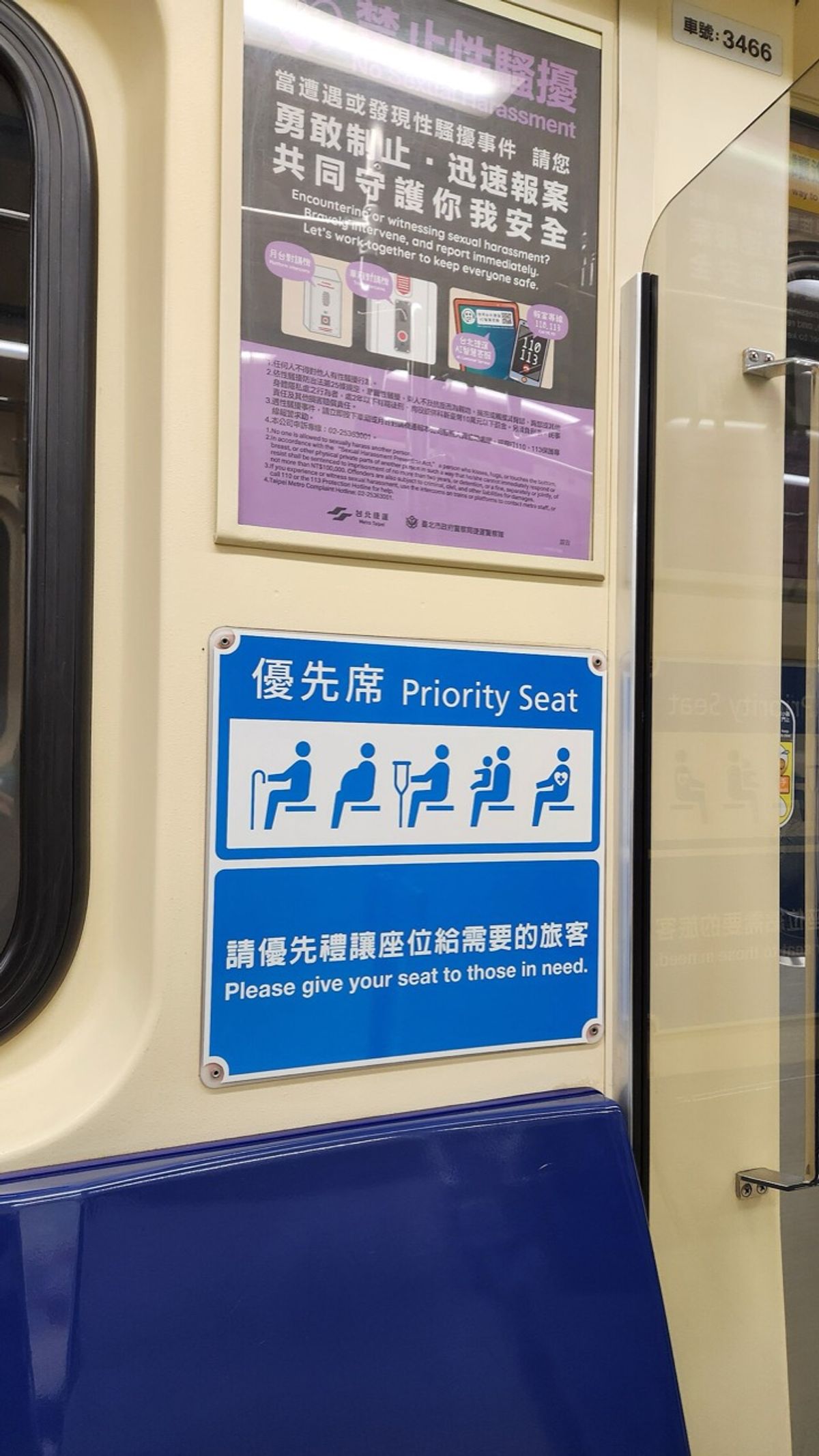
Photo: Sinsyuan via Wikimedia Commons, CC BY-SA 4.0
Priority seats are a real thing. The dark blue seats are 優先席 (priority seats). Until 2025 they were called 博愛座, and they were a running social argument: young people sitting in them got filmed and shamed online. In July 2025 the law was amended to rename them and to say they are for "people with actual needs" (elderly, pregnant, injured, carrying small children, or anyone genuinely unwell), and operators had to swap the signs by the end of 2025. Our advice: if you are healthy, just don't sit there, even when the train is half empty. It is not worth the looks.
For the practical side of riding the system, see our guide to the MRT and EasyCard.
Face and indirect communication
This matters more than any chopstick rule. Taiwanese people generally avoid saying "no" directly, especially to someone they don't know well, and they avoid making anyone lose face in public.
What that sounds like in practice:
- "It's fine" (沒關係) or "no problem" can mean it really is fine, or it can mean "I'm not going to argue with you here." Read tone and follow-up.
- "I'll think about it" or "it's a bit inconvenient" (有點不方便) usually means no.
- A landlord saying "should be okay" (應該可以) about a repair or a pet is not a commitment. Get it in writing in the contract.
Our rule: never criticize someone in front of others. Raise problems one on one, calmly, and give the other side a way to fix it without admitting fault. This is exactly how rent negotiations go well, which we cover in negotiating rent with a Taiwanese landlord.
At someone's home
- Shoes off at the door. Nearly universal in homes, and in many rentals during viewings too. Wear socks without holes. Slippers are usually offered.
- Bring a small gift if invited for a meal: fruit or a box of pineapple cakes is a safe default.
Gift taboos that people actually notice
Some taboos are trivia. These four are not, because they are puns on death or separation that most Taiwanese people, including young ones, will catch:
- Clocks. "Giving a clock" (送鐘) sounds like "attending someone's deathbed" (送終). Never give a clock or a watch as a gift to a host or an older person.
- Umbrellas. 傘 sounds like 散, "to break apart." Avoid giving one to a partner or friend.
- Pears. Sharing a pear (分梨) sounds like separating (分離). Don't cut a pear to share with a partner.
- White envelopes. White envelopes (白包) are for funerals. Money as a gift always goes in a red envelope (紅包, hongbao): for weddings, Lunar New Year and birthdays of elders.
The number 4 sounds like "death" (死). Many buildings skip 4th floors or label them differently, and some apartments on 4th floors or unit number 4 rent slightly cheaper. Avoid amounts with 4 in a red envelope. Wedding red envelopes typically use even, lucky-sounding amounts (NT$1,600, NT$2,200, NT$3,600 are common).
Overhyped by guidebooks: wrapping paper colors and refusing a gift three times. Nobody cares.
Food, chopsticks and the bill
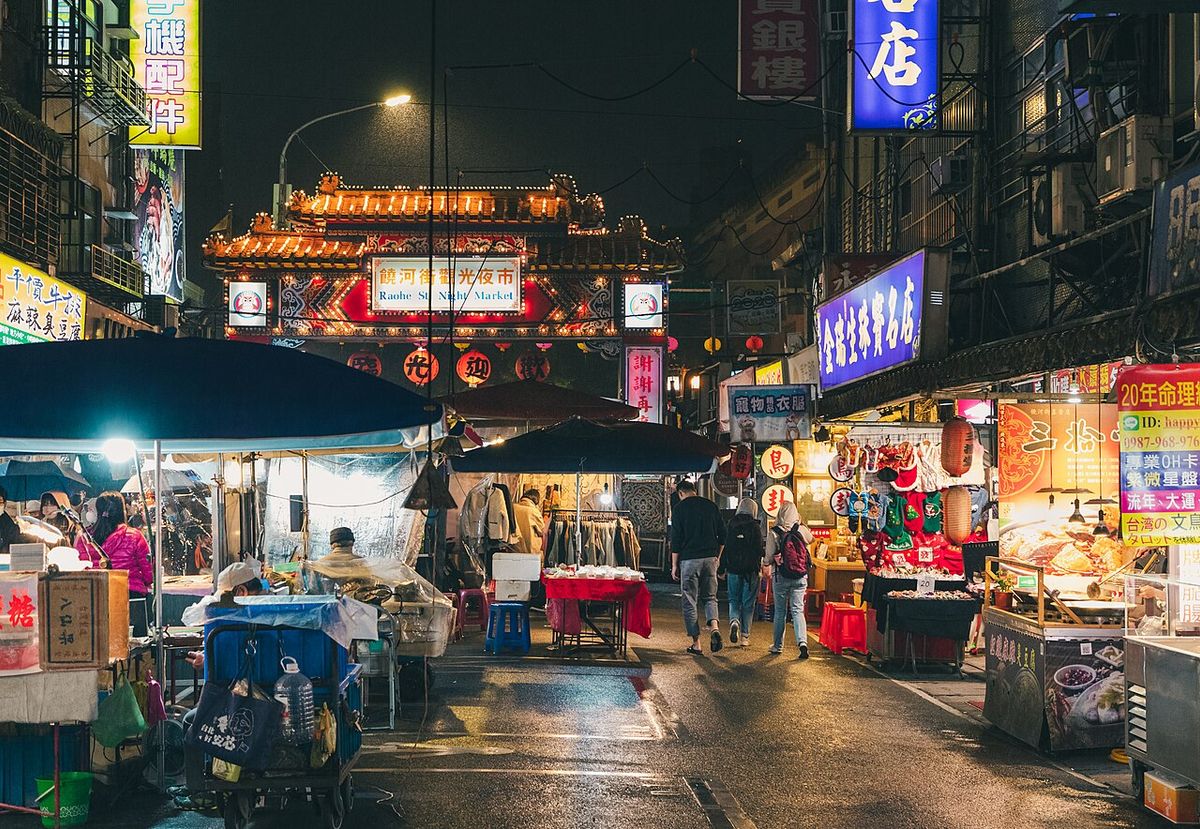
Photo: Ji Soo Song via Wikimedia Commons, CC BY 2.0
Food is the center of social life, and dishes are usually shared family style.
- Don't stand chopsticks upright in a bowl of rice. It looks like incense at a funeral. Lay them across the bowl or on the rest. This is the one chopstick rule that matters.
- Use the serving spoon or serving chopsticks (公筷) for shared dishes when they are provided.
- The bill fight is real. Older colleagues or hosts will often insist on paying, sometimes physically racing you to the counter. If someone treats you, accept graciously and pay next time. Among friends your own age, splitting (AA制) is completely normal.
- Tipping: don't. There is no tipping culture. Sit-down restaurants and hotels usually add a 10% service charge to the bill, and that is it. Taxi drivers, hairdressers and delivery riders do not expect tips.
Our pick for a first night market is Ningxia: small, walkable and food focused, without Shilin's tourist crush.
Temples and religion
Most Taiwanese practice a blend of Buddhism, Taoism and folk religion without labeling which is which.
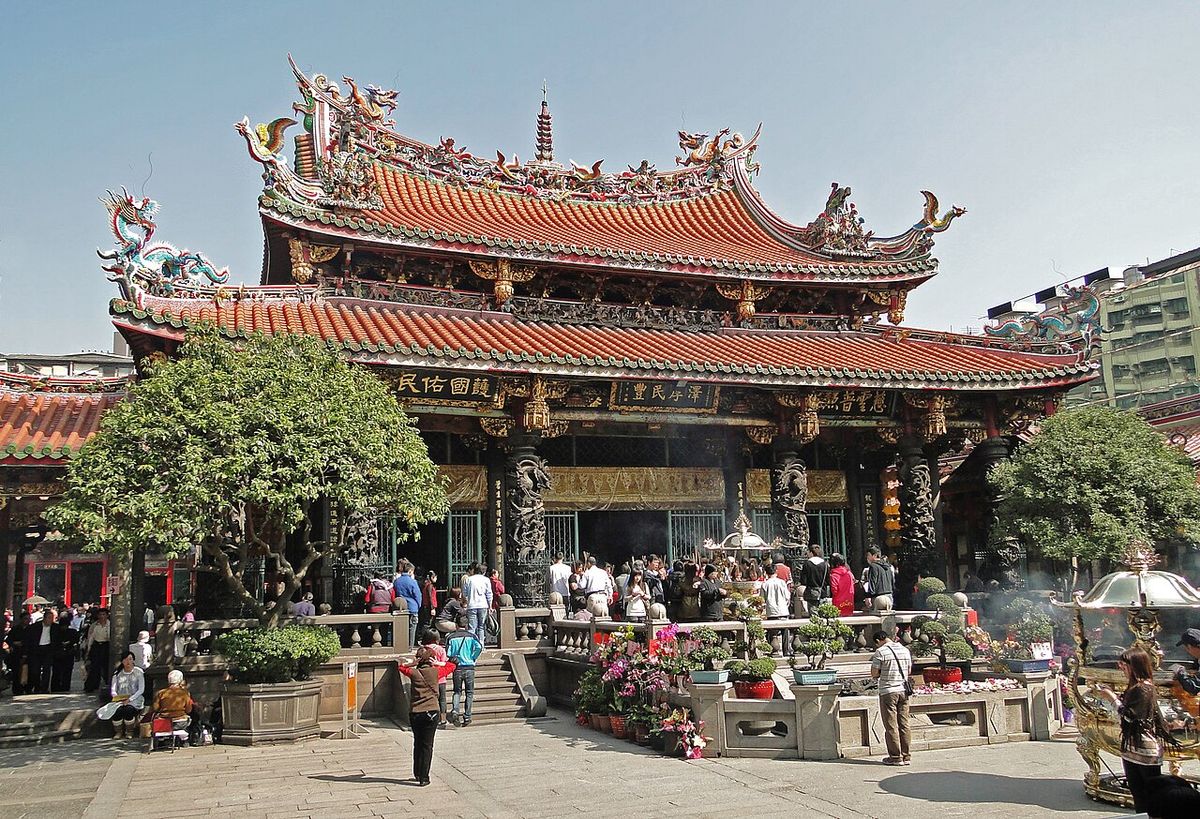
Photo: Bernard Gagnon via Wikimedia Commons, CC BY-SA 3.0
Temple etiquette is simple and visitors are welcome:
- Enter through the right-hand door (dragon side) and leave through the left (tiger side). Don't step on the raised threshold.
- Don't walk directly through the center door, which is for the gods.
- Photos are generally fine, but don't photograph people praying up close.
- Don't touch or move offerings on tables.
Longshan Temple in Wanhua and Xingtian Temple in Zhongshan are the two best first visits. Xingtian is notable for banning burning incense since 2014, so it is calmer than most.
Ghost Month, and why it affects your apartment search
The seventh lunar month is Ghost Month (鬼月), when spirits are believed to roam. In 2026 it ran from August 13 to September 10; the dates move each year, usually falling somewhere in August and early September.
During Ghost Month, many Taiwanese avoid big life decisions: buying property, getting married, and especially moving house or signing a lease. You will see offerings tables outside shops and offices, and some people avoid swimming or going out late.
For you as a foreign tenant, this is a genuine opportunity. Fewer locals move in that month, so some landlords with empty units are more open to negotiating rent or move-in dates, and moving companies can be easier to book. The catch is that Ghost Month overlaps the late-summer student rush, so it doesn't make the whole market quiet. Our guide to the best time of year to rent in Taipei explains how the seasons stack up.
One related thing to know: some landlords will not rent to you, or will ask about it, if a death occurred in the unit. Listings that are mysteriously cheap are sometimes 凶宅 (units where someone died). Ask directly.
The major festivals
- Lunar New Year (late January to mid February): the biggest holiday. Many shops close for several days, landlords and agents become hard to reach, and red envelopes are given to children and elders. Don't plan to sign a lease that week.
- Tomb Sweeping Day (April 4 or 5): a long weekend of grave visits and heavy traffic.
- Dragon Boat Festival (fifth lunar month, usually June): boat races and zongzi (sticky rice dumplings).
- Mid-Autumn Festival (eighth lunar month, September or early October): mooncakes, pomelos and, uniquely in Taiwan, barbecues on every sidewalk and balcony. If neighbors invite you, go.
Politics: how to talk about Taiwan and China
This is the one topic worth getting right. In surveys by National Chengchi University's Election Study Center, a clear majority of people in Taiwan identify as Taiwanese rather than Chinese. Practical rules:
- Say "Taiwan," not "Chinese Taipei" or "the province of Taiwan," in everyday conversation.
- Don't call Taiwanese people "Chinese" unless they describe themselves that way.
- Don't open with "So, is Taiwan a country?" Many people prefer not to talk politics with someone they just met.
On social issues, Taiwan is progressive by regional standards. Same-sex marriage has been legal since May 2019, the first in Asia, and Taipei Pride each October is one of the largest in the region.
Work culture: the legal week is 40 hours, but unpaid "voluntary" overtime is common in tech and finance, a manager's suggestion is usually an instruction, and LINE is the work chat, after hours included.
Language
Mandarin is the main language, written in traditional characters (not the simplified ones used in China), and kids learn pronunciation through Zhuyin (ㄅㄆㄇㄈ), not pinyin. Many people, especially older and southern Taiwanese, also speak Taiwanese Hokkien (台語). Learn 謝謝 (xièxie, thank you) and 不好意思 (bù hǎo yìsi, excuse me) before you land.
The short list
If you remember only five things: no food or water past the MRT gates, stay out of priority seats if you're healthy, never give a clock, don't stand chopsticks in rice, and don't tip. Everything else, people will happily forgive.
If you are planning a move and want someone local to handle viewings, landlord conversations and the unwritten rules for you, our services page explains how TRA works.